The 5 Truths About Staying Relevant as a UX Designer
The 5 Truths About Staying Relevant as a UX Designer
"AI won't replace strategic thinkers. But it will replace designers who only know how to execute. Here's the difference."
Shashank Sharma · Product Designer, Berlin · 8 min read
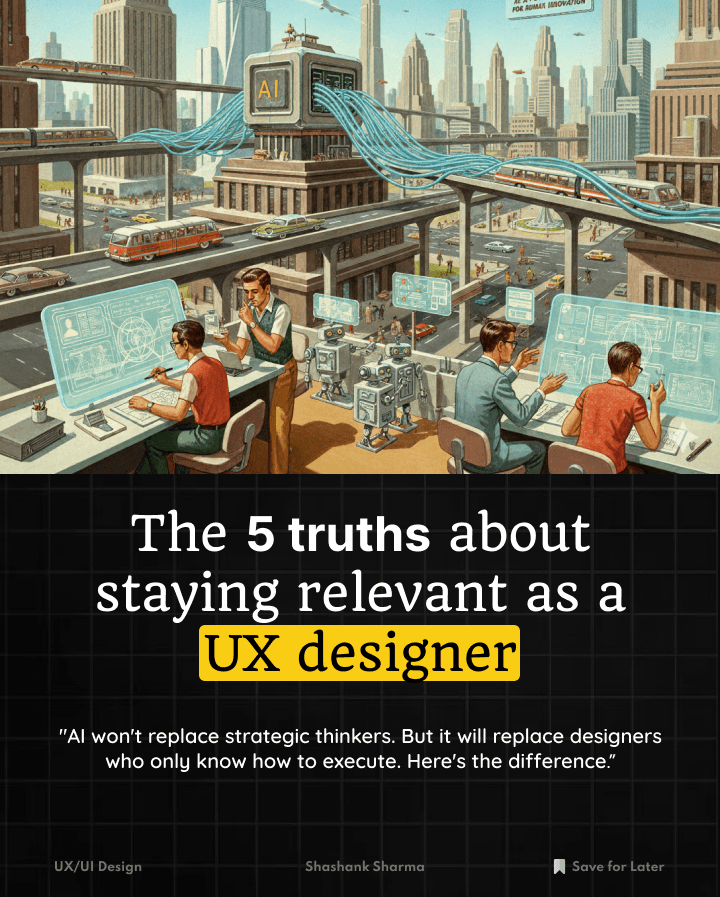
Everyone is talking about AI replacing designers. It's become a tired conversation — half anxiety, half hype. But I think most people are arguing about the wrong thing entirely. The real question isn't whether AI will replace you. It's whether you'll choose to use AI, or try to compete against it.
I've been thinking about this a lot — not in the abstract, doomsday-headline way, but as someone actively building a career in product design right now, in the middle of all this noise. And the more I look at it clearly, the more I see five distinct truths that most designers are either missing or actively misunderstanding.
This is my attempt to lay them out plainly.
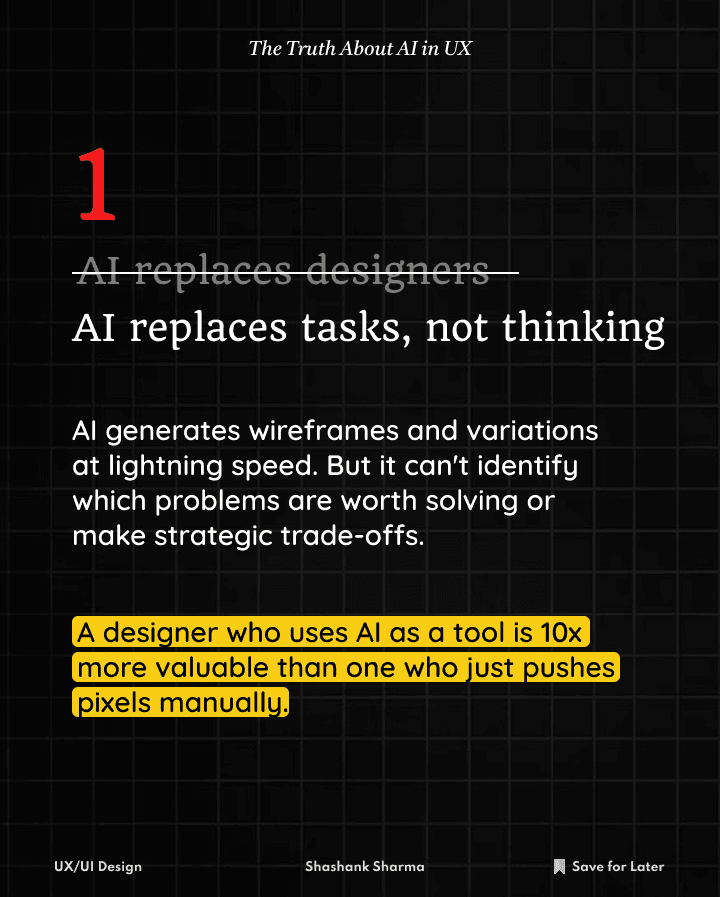
Truth 1: AI replaces tasks, not thinking
Let's start with the claim everyone makes. Yes, AI can now generate wireframes in seconds. It can produce ten visual variations of a layout faster than you can open a new Figma frame. It can write UX copy, generate personas, summarise user research — all at a pace no human designer can match.
But here's what it can't do: look at a product's goals, its business context, its competitive landscape, and its users — and decide which problem is actually worth solving. It can't make the strategic call about what to build and why. It can't navigate the tension between what users ask for and what they actually need. It can't sit in a stakeholder meeting and read the room.
A designer who uses AI as a tool is dramatically more productive than one who doesn't. But the leverage comes from using AI to amplify thinking, not substitute for it. The moment you outsource the thinking itself, you've made yourself redundant.
A designer who uses AI as a tool is 10x more valuable than one who just pushes pixels manually.
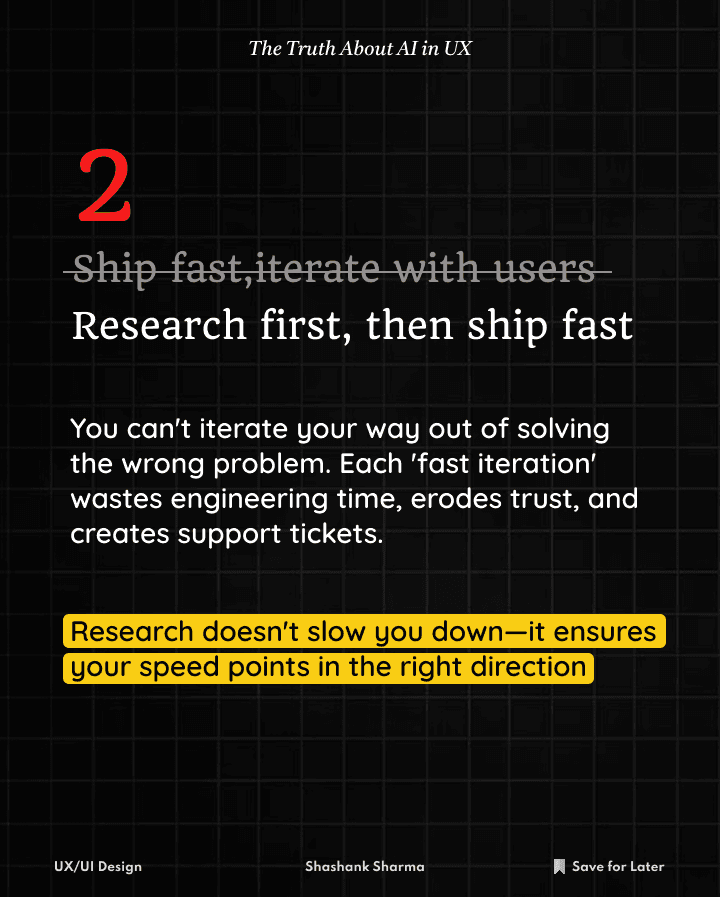
Truth 2: Research first, then ship fast
The "move fast and break things" philosophy has its appeal. And in some contexts — stable markets, well-understood users, low-risk features — iteration speed genuinely is a competitive advantage. But there's a version of this that gets used to justify skipping research entirely, and that version is quietly destroying products.
You cannot iterate your way out of building the wrong thing. Every fast iteration on the wrong problem wastes engineering cycles, ships confusion to users, creates support tickets, erodes trust, and accumulates technical debt. It looks like progress. It isn't.
Research doesn't slow you down. It re-orients your speed. It's the difference between running fast and running fast in the right direction. A few days of user interviews before building can save months of rework afterward.
This is especially true when AI is involved. AI makes it easier to produce more, faster — which means the cost of producing the wrong thing faster is also higher. Research isn't a bottleneck. It's a multiplier.
Research doesn't slow you down — it ensures your speed points in the right direction.
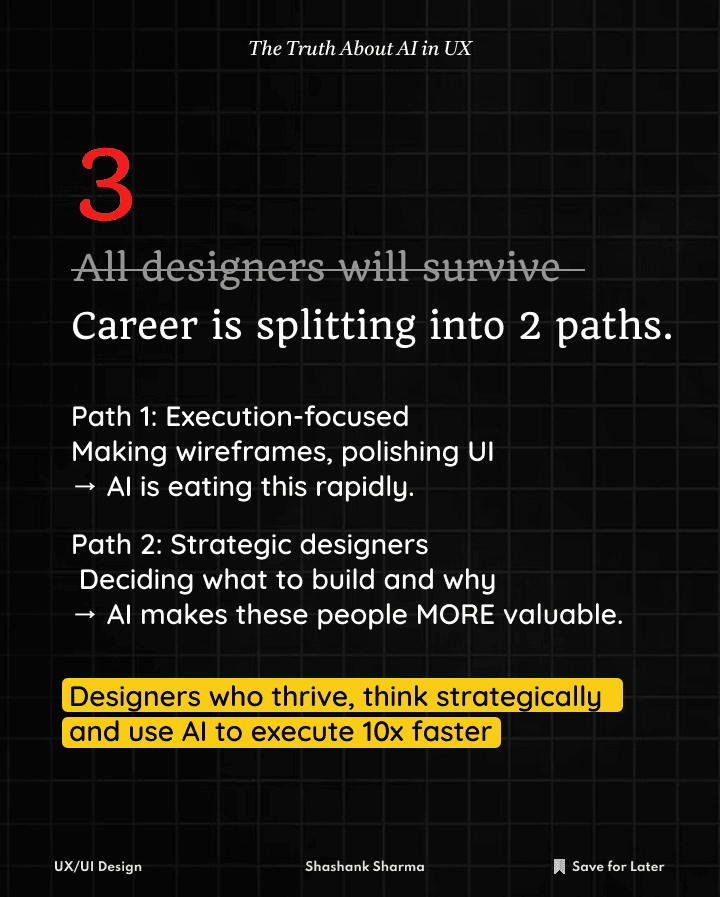
Truth 3: The career is splitting into two paths
This is the one most people don't want to hear, but I think it's the most important: the design profession is not facing uniform pressure from AI. It's bifurcating. There are now two very different career trajectories opening up, and which one you're on depends largely on the choices you make in the next one to three years.
Path 1 — Execution-focused: Making wireframes, polishing UI, producing assets, iterating on visual treatments. AI is eating this rapidly.
Path 2 — Strategic designers: Deciding what to build and why. Synthesising research. Navigating stakeholder tensions. Framing problems before anyone starts designing solutions. AI makes these people more valuable, not less.
The designers who will thrive are those who move toward Path 2 while using AI to handle Path 1 tasks in a fraction of the time it used to take. They become multiplied, not replaced. The designers who will struggle are those who stay entirely on Path 1 and try to compete against AI on its own terms.
To be clear: execution skills still matter. You need to be able to build things. But building things is no longer sufficient. You need to know which things to build — and why.
Designers who thrive think strategically and use AI to execute 10x faster.
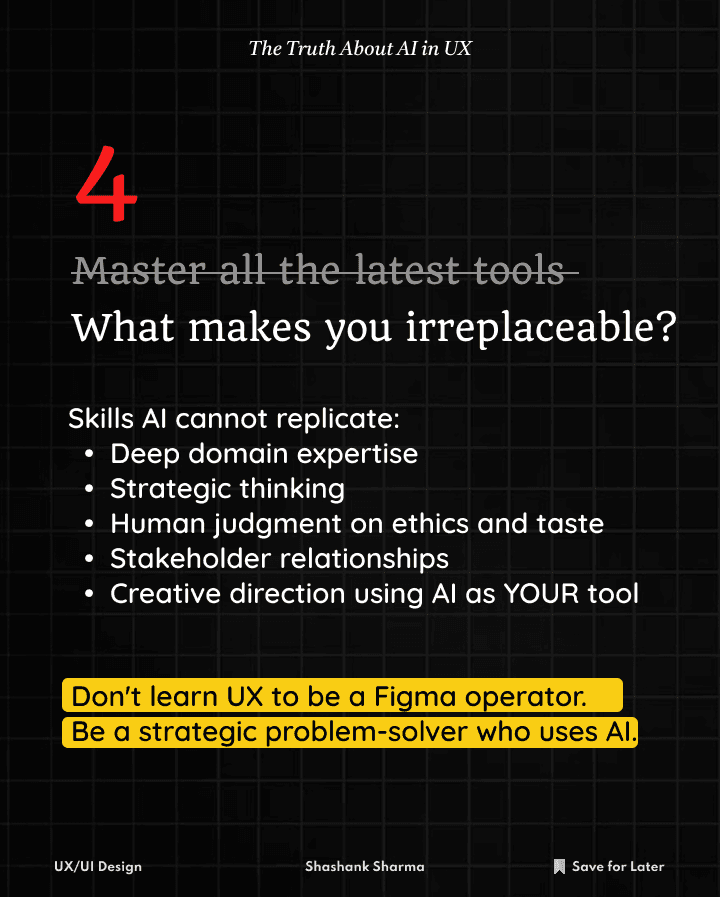
Truth 4: What actually makes you irreplaceable?
Master all the latest tools
Every few months there's a new AI design tool that everyone is rushing to learn. And yes, staying current matters — being comfortable with AI-assisted workflows is now table stakes. But the framing of "master all the tools" is subtly wrong in a way that can trap you.
Tools are commoditised almost as soon as they appear. The specific tool you use today will be replaced by a better one next year. The knowledge that lasts is not tool-specific — it's the underlying thinking that makes you valuable regardless of which tools exist.
What AI can do: generate wireframes at scale, produce visual variations, write UX copy drafts, summarise research, create design system components.
What AI still can't do: develop deep domain expertise, frame strategic problems, exercise human judgment on ethics and taste, build stakeholder relationships, provide creative direction with genuine intent.
The skills in that second list take years to develop, can't be compressed into a tutorial, and don't become obsolete when the next tool drops. They're also, not coincidentally, the skills that correlate most strongly with seniority and career longevity.
Don't learn UX to be a Figma operator. Learn it to be a strategic problem-solver who happens to use Figma — and Claude, and whatever comes next.
Don't learn UX to be a Figma operator. Be a strategic problem-solver who uses AI.
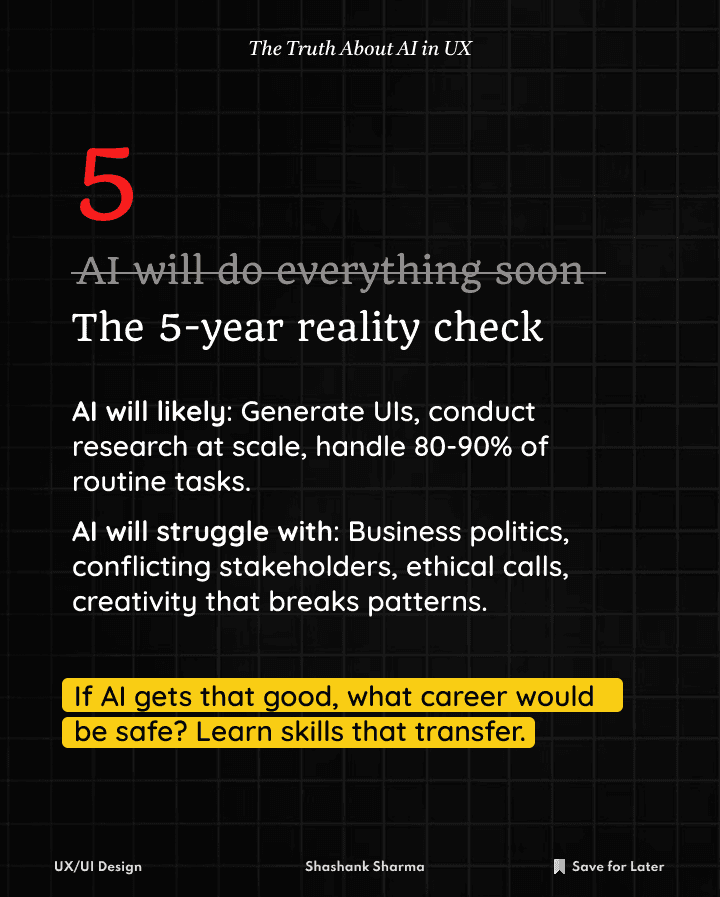
Truth 5: The honest 5-year reality check
AI will do everything soon
Let's be clear-eyed about where this is actually heading, rather than defaulting to either panic or complacency. AI will get dramatically better over the next five years. That's not speculation — it's already happening at a pace most people are underestimating.
What AI will almost certainly be able to do: generate production-ready UIs, conduct research synthesis at scale, handle 80–90% of the routine design tasks that currently occupy most of a junior designer's week. The execution-heavy work will become increasingly automated.
What AI will continue to struggle with: business politics. Conflicting stakeholders with legitimate competing interests. Ethical calls that require understanding of cultural context, power dynamics, and human values. Creativity that genuinely breaks patterns rather than recombining existing ones. The judgment calls that only come from being a human in the world.
Here's the uncomfortable question this raises: if AI gets good enough to handle all of that — then honestly, no career is entirely safe, not just design. At that point, the only viable strategy is to have built skills that transfer broadly: communication, judgment, strategy, ethics, domain expertise. These are human skills, not just designer skills. And they're worth cultivating regardless of how the AI story plays out.
If AI gets that good, what career would be safe? Learn skills that transfer.
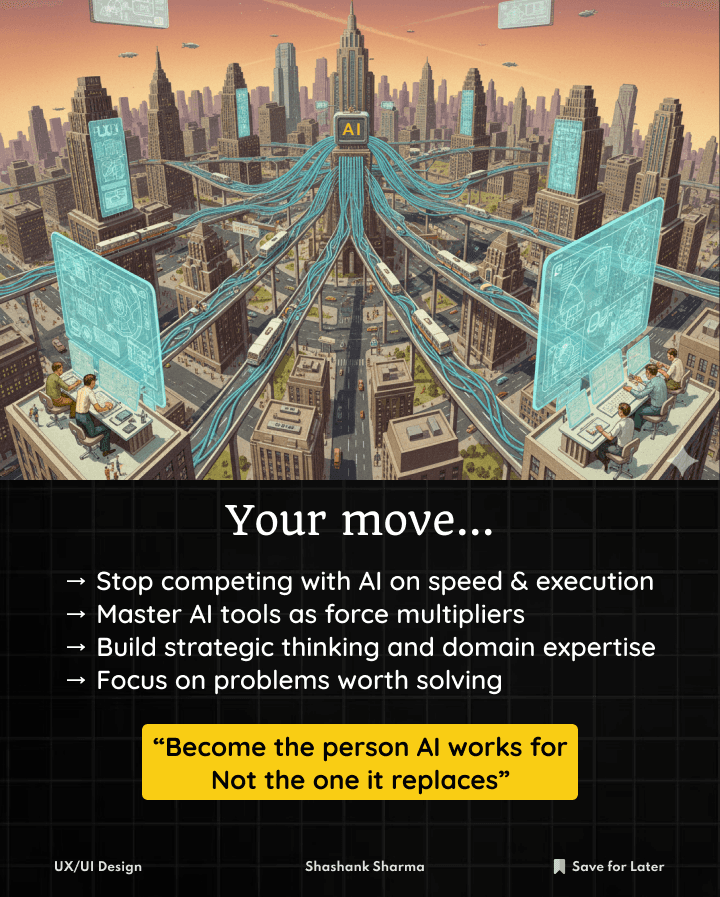
So, what do you actually do with all of this?
Stop competing with AI on speed and execution. You will lose that race. It is not winnable, and it's not even the race worth running.
Start treating AI as a force multiplier for everything that used to be time-consuming. Let it generate the first wireframe draft while you spend that saved time doing a user interview. Let it produce ten layout variations while you think about which problem you're actually solving. Use the speed AI gives you to do more of the work that only you can do.
Build your strategic thinking deliberately. Take on projects where you have to make decisions, not just execute them. Ask to be in the stakeholder meetings. Volunteer to frame the problem before anyone starts designing solutions. Write about your reasoning publicly — not just the work, but the thinking behind the work.
Develop genuine domain expertise in something. AI generalists are everywhere. Designers who deeply understand fintech, or healthcare, or B2B SaaS, or accessibility — people who speak the domain's language, know its constraints, understand its users at a real depth — are valuable in ways that are hard to replicate quickly.
The designers who will look back on this period as the best thing that happened to their career are the ones who used the disruption as a forcing function — to move up the value chain, to develop the skills they'd been meaning to develop, to stop hiding in execution and start showing up as strategic partners.
"Become the person AI works for. Not the one it replaces."